%20(1).gif)

IB SUBJECTS OFFERED AT PRVA GIMNAZIJA VARAŽDIN 2023-2024
|
group |
Group title |
Subject
|
|
1 |
STUDIES IN LANGUAGE AND LITERATURE |
CROATIAN A Literature ENGLISH A Literature |
|
2 |
LANGUAGE ACQUISITION |
ENGLISH B |
|
SPANISH ab initio |
||
|
3 |
INDIVIDUALS AND SOCIETIES |
BUSINESS MANAGEMENT (BM) |
|
GEOGRAPHY |
||
|
PSYCHOLOGY |
||
|
3/4 |
INTERDISCIPLINARY |
ENVIRONMENTAL SYSTEMS AND SOCIETIES |
|
4 |
SCIENCES |
BIOLOGY |
|
CHEMISTRY |
||
|
COMPUTER SCIENCE (CS) |
||
|
PHYSICS |
||
|
5 |
MATHEMATICS Analysys & Approaches |
MATHEMATICS HL |
|
MATHEMATICS SL |
||
|
6 |
THE ARTS |
VISUAL ARTS (VA) |
CURRICULUM
STUDIES IN LANGUAGE AND LITERATURE
LANGUAGE A
All IB students are expected to study their own language. This course aims to develop student’s the skills in critical reading and textual analysis of literary works. Students have the opportunity to explore literary works from different cultures and times. The course will introduce students to ways of approaching and studying literature, leading to development of an understanding and appreciation of the relationships between different works. HL students will read fifteen works (SL 11 works), including novels, plays, poetry, and non-fiction prose. Class work will include writing assignments, presentations and class discussions.
There are three assessed components in Language A1: world literature essays (externally assessed, 20% of final grade), two internally assessed orals (30% of final grade), and written examination (commentary and essay) for 50%. Prva gimnazija Varaždin offers Croatian A and English A.
New programme from september 2019.
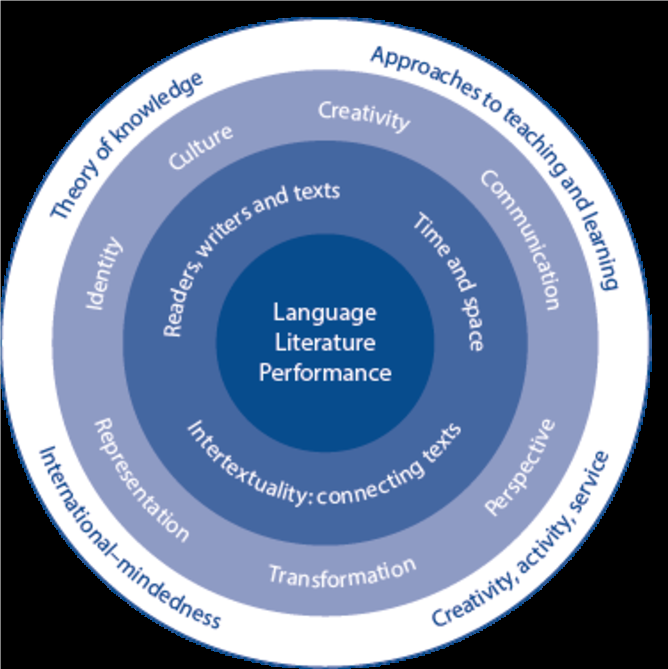
|
Syllabus component |
|
Readers, writers and texts Works are chosen from a variety of literary forms. The study of the works could focus on the relationships between literary texts, readers and writers as well as the nature of literature and its study. This study includes the investigation of the response of readers and the ways in which literary texts generate meaning. The focus is on the development of personal and critical responses to the particulars of literary texts. |
|
Time and space Works are chosen to reflect a range of historical and/or cultural perspectives. Their study focuses on the contexts of literary texts and the variety of ways literary texts might both reflect and shape society at large. The focus is on the consideration of personal and cultural perspectives, the development of broader perspectives, and an awareness of the ways in which context is tied to meaning. |
|
Intertextuality: Connecting texts Works are chosen so as to provide students with an opportunity to extend their study and make fruitful comparisons. Their study focuses on intertextual relationships between literary texts with possibilities to explore various topics, thematic concerns, generic conventions, literary forms or literary traditions that have been introduced throughout the course. The focus is on the development of critical response grounded in an understanding of the complex relationships among literary texts. |
|
Works read |
Assessment component |
||||||
|
|
SL |
HL |
External assessment |
SL |
SL |
HL |
HL |
|
Works in translation |
Study of a minimum of 3 works |
Study of a minimum of 4 works |
Paper 1: Guided literary analysis |
35% |
70%
|
35% |
80%
|
|
Works originally written |
Study of a minimum of 4 works |
Study of a minimum of 5 works |
Paper 2 Comparative essay |
35% |
25% |
||
|
Free choice works |
Study of 2 works freely chosen |
Study of 4 works freely chosen |
Higher level (HL) essay |
/ |
20% |
||
|
Total works studied |
9 |
13 |
Internal assessment |
30% |
30% |
20% |
20% |
|
Individual oral |
|||||||
LANGUAGE ACQUISITION
ENGLISH B
English B is a two-year course for students with some previous experience of learning the language. The course is taught at both higher and standard level. The main focus of this course is on language acquisition and the development of four skills (listening, speaking, reading and writing), which will be achieved through the use of a wide range of texts or material (textbooks, the media, literary texts).
English B is assessed using both internal and external assessment. External assessment includes the final exam taken in May and it consisits of two papers generally written on successive days. Paper1 takes 90 minutes and includes questions based on three written texts and a short writing exercise as a response to the fourth written text. Paper 2 also takes 90 minutes; students chose one writing task out of six.Internal assessment takes place during the final year of the course and includes interactive oral (three oral activities to be internally assessed by the teacher and externally moderated by the IBO) and individual oral (recorded by the teacher and sent for moderation).
GERMAN B
German B is a two-year course for students with some previous experience of learning the language. The course is taught at both higher and standard level. The main focus of the German B course is on language acquisition and development in the four primary language skills: listening, speaking, reading and writing. These language skills will be developed through the study and use of a range of written and spoken material.
German B is assessed using both internal and external assessment.
External assessment includes the final exam taken in May and it consists of two papers. Paper 1 takes 90 minutes and includes questions based on three written texts and a short writing exercise as a response to the fourth written text. Paper 2 also takes 90 minutes; students chose one writing task out of four at standard level and six tasks at higher level.
Internal assessment takes place during the final year of the course and includes interactive oral (three oral activities to be internally assessed by the teacher and externally moderated by the IBO) and individual oral (recorded and assessed by the teacher and sent for moderation.)
INDIVIDUALS AND SOCIETIES
BUSINESS MANAGEMENT
The business management subject is designed to develop students’ knowledge and understanding of business management theories, as well as their ability to apply a range of tools and techniques. Students learn to analyse, discuss and evaluate business activities at local, national and international levels. The course covers a range of organizations from all sectors, as well as the socio-cultural and economic contexts in which those organizations operate.
The course covers the key characteristics of business organization and environment and the business functions of human resource management, finance and accounts, marketing and operations management. Through the exploration of four underpinning concepts (change, ethics, creativity and sustainability), the course allows students to develop a holistic understanding of today’s complex and dynamic business environment. The conceptual learning is placed in the context of real world examples and case studies.
The HL course in business management differs from the SL course in business management in terms of the recommended hours devoted to teaching (240 hours for HL compared to 150 hours for SL), extra depth and breadth required (extension units for HL), nature of the examination questions and additional paper three on exams.
External assessment for SL students consists of two written examination papers: paper one (based on a pre-released statement that specifies the context and background for the unseen case study), and paper two (based on the unseen stimulus material with a quantitative focus). Internal assessment for SL students is a research project in which students study real world business organizations. Internal assessment is the same for HL students.
External assessment for HL students consists of two examination papers that are similar to examination papers for SL students, with questions that cover additional syllabus units for HL. Students on HL have an additional paper three, which focuses on social enterprise.
GEOGRAPHY
“Geography is the only subject that has given me the skills to interpret and understand reality in a way I could not imagine before and that will remain for life.” (British School student of Rio de Janeiro (2013))
|
Geography is a dynamic subject that is focuses on the interactions between individuals, societies and physical processes in both time and space. It seeks to identify trends and patterns in these interactions. It also investigates the way in which people adapt and respond to change, and evaluates actual and possible management strategies associated with such change. |
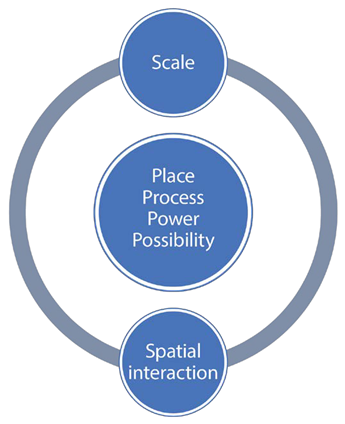 |
| 1. Geography concepts |
Geographic skills are essential to the study of geography and reflect the subject’s distinctive methodology and approach. Teaching and learning these skills enriches the students’ understanding of geography and enables them to apply and use appropriate techniques and terminology.
Syllabus is divided intro three parts:
Part One: Geographic themes—seven options (two options are studied at SL, and three at HL)
Freshwater—drainage basins, Oceans and coastal margins, Extreme environments,
Geophysical hazards, Leisure, tourism and sport, Food and health, Urban environments.
Part two: Geographic perspectives— global change (SL and HL core)
Population distribution—changing population, Global climate— vulnerability and resilience
Global resource consumption and security
Part three: Geographic perspectives—global interactions (HL only)
Power, places and networks, Human development and diversity, Global risks and resilience
Geography encourages the development of strong written, verbal, and visual or graphical communication skills; critical and complex thinking; and ethical considerations that will assist students in preparing for the future global workplace
PSYCHOLOGY
Psychology is the systematic study of mental processes and behaviour. It is a complex subject which draws on concepts, methods and understandings from a number of different disciplines.
At the core of the DP psychology course is an introduction to three different approaches to understanding behaviour (biological, cognitive and sociocultural approach).
The aims of the psychology course at SL and at HL are to:
- develop an understanding of the biological, cognitive and sociocultural factors affecting mental processes and behaviour
- apply an understanding of the biological, cognitive and sociocultural factors affecting mental processes and behaviour to at least one applied area of study
- understand diverse methods of inquiry
- understand the importance of ethical practice in psychological research in general and observe ethical practice in their own inquiries
- ensure that ethical practices are upheld in all psychological inquiry and discussion
- develop an awareness of how psychological research can be applied to address real-world problems and promote positive change
The knowledge, concepts, theories and research that have developed the understanding in these fields will be studied and critically evaluated to answer some of the questions being asked by psychologists today. The contribution and the interaction of the three approaches can be best understood through the options. The options of the course focus on areas of applied psychology: abnormal psychology, developmental psychology, health psychology and psychology of human relationships.
The options provide an opportunity to take what is learned from the study of the approaches to psychology and put it into the context of specific lines of inquiry, broaden students’ experience of the discipline and develop the students’ critical inquiry skills. Surrounding the approaches and the options are the overarching themes of research and ethics.
There are several main distinctions between this course at SL and at HL. The HL course in psychology differs from the SL course in terms of the recommended hours devoted to teaching and extensions to the core approaches, which are studied at HL only. SL students are required to study one option while HL students study two options. Both SL and HL students will be expected to show their understanding of approaches to research in the internal assessment and for critical thinking in paper 1 and paper 2 responses. Additionally, HL students will be directly assessed on their understanding of approaches to research in paper 3 of the external assessment. This will cover both qualitative and quantitative research methods.
INTERDISCIPLINARY
ENVIRONMENTAL SYSTEMS & SOCIETIES (ESS)
ESS is an interdisciplinary group 3 and 4 course that is offered only at standard level (SL). As an interdisciplinary course, ESS is designed to combine the methodology, techniques and knowledge associated with group 4 (sciences) with those associated with group 3 (individuals and societies). Because it is an interdisciplinary course, students can study ESS and have it count as either a group 3 or a group 4 course, or as both. If students choose the latter option, this leaves the opportunity to study an additional subject from any other group, including an additional group 3 or group 4 subject.
ESS is a complex course, requiring a diverse set of skills from its students. It is firmly grounded in both a scientific exploration of environmental systems in their structure and function and in the exploration of cultural, economic, ethical, political, and social interactions of societies with the environment.
Because of that, ESS will enable students to adopt and develop an informed personal response to the wide range of pressing environmental issues that they will inevitably come to face.
The interdisciplinary nature of the course requires a broad skill set from students and includes the ability to perform research and investigations and to participate in philosophical discussion. The course requires a systems approach to environmental understanding and problem solving, and promotes holistic thinking about environmental issues.
The central concepts of the ESS course include sustainability, equilibrium, strategy, biodiversity and EVSs.
Many of the issues encountered in the course and beyond, such as resource management, pollution, globalization and energy security, are linked to these concepts and so it is important that these issues be emphasized in each context. The big questions, listed at the end of this section, provide a focus for re-examining these concepts in a variety of ways as the course progresses.
Some of the aims of the ESS course are to enable students to:
- apply the knowledge, methodologies and skills to analyses environmental systems and issues at a variety of scales
- appreciate the dynamic interconnectedness between environmental systems and societies
- value the combination of personal, local and global perspectives in making informed decisions and taking responsible actions on environmental issues
- be critically aware that resources are finite, and that these could be inequitably distributed and exploited, and that management of these inequities is the key to sustainability
- engage with the controversies that surround a variety of environmental issues
During the course, students will study eight (8) different topics: Foundations of environmental systems and societies, Ecosystems and ecology, Biodiversity and conservation, Water and aquatic food production systems and societies, Soil systems and terrestrial food production systems and societies, Atmospheric systems and societies, Climate change and energy production and Human systems and resource use. An important aspect of the ESS course is hands-on work in the laboratory and out in the field.
At the end of the course, student’s knowledge will be assessed both internally by the school and externally by the IB organization. External assessment consists of 2 papers, Paper 1 contribute 25% and Paper 2 contribute 50% of the final grade. Additional 25% of the final grade is based on practical work carried out and recorded by the students (internal assessment).
SCIENCES
BIOLOGY
Biology is the study of the living organisms. The IB Biology course will provide a broad understanding of core concepts in biology such as to prepare the student for the IB examinations and for successful academic careers in science at the university level. It is hoped that students will acquire a large body of facts, and at the same time develop a broad, general understanding and appreciation of the underlying biological concepts. Through studying the Biology programme students will also develop their ability to analyze and evaluate scientific information critically and to recognize the limitations of scientific knowledge.
Major areas covered include the following: cells and chemistry of life, genetics, human and health physiology, ecology and evolution. Two options must also be studied.
Standard level students study the same topics as those higher level, but higher level students also have to cover extension material on some topics. Fieldwork is an important part of the course and will be undertaken at various levels.
Assessment for the IB Diploma is based on a combination of external examinations, taken at the end of the course, and internal assessment carried out by the Biology teacher. The two means of assessment are weighted 76% and 24% respectively. The external exams consist of 3 papers, occupying a total of 3 hours at standard level and 4.5 hours at higher level. Internal assessment consists of an interdisciplinary science project, known as the Group 4 project, and a mixture of short and long term investigations that would be a part of the normal teaching process. These would be used to assess the students on 8 different assessment criteria.
CHEMISTRY
Chemical principles underpin the physical environment in which we live and all biological systems. The unifying principles of chemistry are developed in a logical way, with laboratory investigations providing a basis for this development. In this programme great emphasis will be placed on experimentation and observation to enhance and develop experimental and practical skills.
Major areas of study include the following: measurement and data processing, stoichiometric relationships, atomic structure, periodicity, chemical bonding and structure, energetics and thermochemistry, chemical kinetics, equilibrium, acids and bases, redox processes and organic chemistry. Both HL and SL students select one option to study which allows flexibility to tailor the course to meet the needs of students.
Grades for IB candidates will be determined by internal school assessment and external evaluation by the IB organization. The external exams consist of 3 papers, occupying a total of 3 hours at standard level and 4.5 hours at higher level. Internal assessment is based on practical work carried out and recorded by the students, databases or models and simulations. Students will participate in the group 4 project which is a collaborative activity where students from different group 4 subjects work together on a scientific or technological topic. Ongoing assessment will be done in the form of unit exams, cooperative learning activities, assignments, homework, notebook, labs and portfolio.
PHYSICS
Physics in the IB Diploma programme consists of standard level (SL) and high level(HL) . Both levels have 80 hours of common programme which includes: physical measurements, mechanics, thermal physics, oscillations and waves, electric currents, fields and forces, atomic and nuclear physics, energy, power and climate change. High level has 55 hours of additional topics: motions and fields, thermal physics, wave phenomena, electromagnetic induction, quantum physics and nuclear physics, digital technology. Both, students of SL and HL have to choose two options of the following: SL ( 15 hours) sight and wave phenomena, quantum and nuclear physics, digital technology, relativity and particle physics, astrophysics communications, electromagnetic waves, HL (22) astrophysics communications, electromagnetic waves, relativity, medical physics and particle physics.
Students of SL have to perform 30 hours of practical work while students of HL, 50 hours. Students attending physics participate with other students of a science subject in the Group Four Project. During the course students are often assessed in the form of IB exams. The mark at the final exam consists of 76% external evaluation (tests) and 24% internal evaluation ( practical work).
The Physics course prepares students very well for the university, where physics is highly presented (medicine, electro technical sciences and others).
COMPUTER SCIENCE
The subject Computer Science explores the principles underlying problem-solving using computers as well as operation of computer systems. The emphasis should be on the use of logical approach and analytical thinking.
Students are expected to acquire mastery aspects of Java which are defined as the ability to use for some non-trivial purpose.
Standard level (SL) course focuses on fundamentals of computer systems, software development and the relationship between computing systems and society.
The higher level (HL) course includes all these elements with addition topics: computer mathematics and logic, advanced data structures and algorithms, further system fundamentals and file organization.
Assessment is divided into the external and internal part. The external part is conducted at the end of the programme of study and amounts to 65% and the internal part is carried out by teachers and amounts to 35%. The external assessment consists of Paper 1 and Paper 2. Paper 1 is an examination paper with compulsory sections and Paper 2 is an examination paper with compulsory sections and the third part is based on a case study. The internal part consists of the program dossier. The Program dossier is an individual well documented piece of work which is completed during the course in the Java programming language and is internally assessed by the teacher and externally moderated by the IBO.
MATHEMATICS
MATHEMATICS ANALYSIS AND APPROACHES HL SL
Mathematics: analysis and approaches SL and HL are core IB subjects, in Group 5. Students who choose Mathematics: analysis and approaches at SL or HL should be comfortable in the manipulation of algebraic expressions and enjoy the recognition of patterns and understand the mathematical generalization of these patterns.
The syllabuses for both of them are in a way similar but the approach is different. HL relies on mathematical rigor i.e. proving of most statements, a welcome approach for further learning of mathematical subjects in various universities. In SL, only the basic proofs are required from students although during the course they are exposed to methods and logic of mathematical thinking. Both versions have many near real-life examples. Students who wish to take Mathematics: analysis and approaches at higher level will have strong algebraic skills and the ability to understand simple proof. They will be students who enjoy spending time with problems and get pleasure and satisfaction from solving challenging problems. SL (Standard level) reaches for students oriented towards non-technical university education such as Economics, Psychology, Business or Medicine while HL prepares students for further education in natural and technical sciences.
Both versions follow similar course requirements, but with different tests and portfolio tasks.
As a rule, GDC (graphic display calculator) is used throughout the course and is an obligatory instrument at the final exam. Students are expected to learn how to use it and it is encouraged in the general technology usage. Although not required, a personal computer is welcome to have not only some standard software, but also some additional ones for mathematical purposes such as graphing.
Mathematics encourages students to think in a systematic way, to organize data and methodically solve problems they are confronted with. These abilities are useful in every aspect of education and everyday life with mathematics being the most efficient tool to learn and develop them.
The Syllabus is divided into five mandatory chapters at both levels:
- Number and algebra
- Functions
- Geometry and trigonometry
- Statistics and probability
- Calculus
The final exam in mathematics consists of two parts: external and internal assessment. External assessment (which makes up 80% of the final grade) consists of two papers at the standard level and three papers at the higher level. The first paper (Paper 1) is written by students without the use of GDC, while the second (Paper 2) requires the use of a graphing calculator. At a higher level, students also solve the third test (Paper 3) in which they face completely new mathematical problems. The internal assessment requirements at SL and at HL is an individual exploration. This is a piece of written work that involves investigating an area of mathematics (makes up 20% of the final grade).
|
STANDARD LEVEL
|
HIGHER LEVEL
|
THE ARTS
VISUAL ARTS
Visual arts is an elective, but not a compulsory subject in IB curricular model. Students thinking of choosing VA should be enthusiastic and keen on dealing with art, prepared to widen their perspectives, learn more and put a great deal of self effort into personal development in this field.
The Visual arts curriculum is based on Modern and contemporary art topics and problems, developed through the 19th and 20th century discourse. Certain stylistic and aesthetic issues are compulsory related with some earlier art periods like renaissance, baroque, classicism and others.
Visual arts syllabus suggests that all of curriculum issues should be considered and explored both in theoretical and practical way. An investigative approach to all topics is strongly recommended.
Mapping the course
Students are required to investigate the core syllabus areas through exploration of the following practices:
theoretical practice
art-making practice
curatorial practice.
The table below shows how these activities link with the core syllabus areas at both SL and HL.
|
Visual arts in context |
Visual arts methods |
Communicating visual arts |
|
|
Theoretical practice |
Students examine and compare the work of artists from different cultural contexts. Students consider the contexts influencing their own work and the work of others. |
Students look at different techniques for making art. Students investigate and compare how and why different techniques have evolved and the processes involved. |
Students explore ways of communicating through visual and written means. Students make artistic choices about how to most effectively communicate knowledge and understanding. |
|
Art-making practice |
Students make art through a process of investigation, thinking critically and experimenting with techniques. Students apply identified techniques to their own developing work. |
Students experiment with diverse media and explore techniques for making art. Students develop concepts through processes that are informed by skills, techniques and media. |
Students produce a body of artwork through a process of reflection and evaluation, showing a synthesis of skill, media and concept. |
|
Curatorial practice |
Students develop an informed response to work and exhibitions they have seen and experienced. Students begin to formulate personal intentions for creating and displaying their own artworks. |
Students evaluate how their ongoing work communicates meaning and purpose. Students consider the nature of “exhibition” and think about the process of selection and the potential impact of their work on different audiences. |
Students select and present resolved works for exhibition. Students explain the ways in which the works are connected. Students discuss how artistic judgments impact the overall presentation. |
Online izdanje

ARHIVA:
Tehničke preporuke: za čitanje kliknite na naslovnicu. Pregled se preporuča u Chrome, Mozilla Firefox preglednicima i s normalnom veličinom fonta podešenom na mobilnim uređajima.



.png)






Pratite zanimljive članke koje na engleskom jeziku pišu naši učenici, polaznici grupe English news agency (klik na logo)!

Ukupno: 3438957
Ovaj mjesec: 16882
Ovaj tjedan: 1809
Danas: 10
| Obrazovanje |  |
 |
| Dnevni tisak | |
|
| e-knjiznica | |
|
| « Srpanj 2024 » | ||||||
| Po | Ut | Sr | Če | Pe | Su | Ne |
| 1 | 2 | 3 | 4 | 5 | 6 | 7 |
| 8 | 9 | 10 | 11 | 12 | 13 | 14 |
| 15 | 16 | 17 | 18 | 19 | 20 | 21 |
| 22 | 23 | 24 | 25 | 26 | 27 | 28 |
| 29 | 30 | 31 | 1 | 2 | 3 | 4 |
| 5 | 6 | 7 | 8 | 9 | 10 | 11 |




.jpg)